
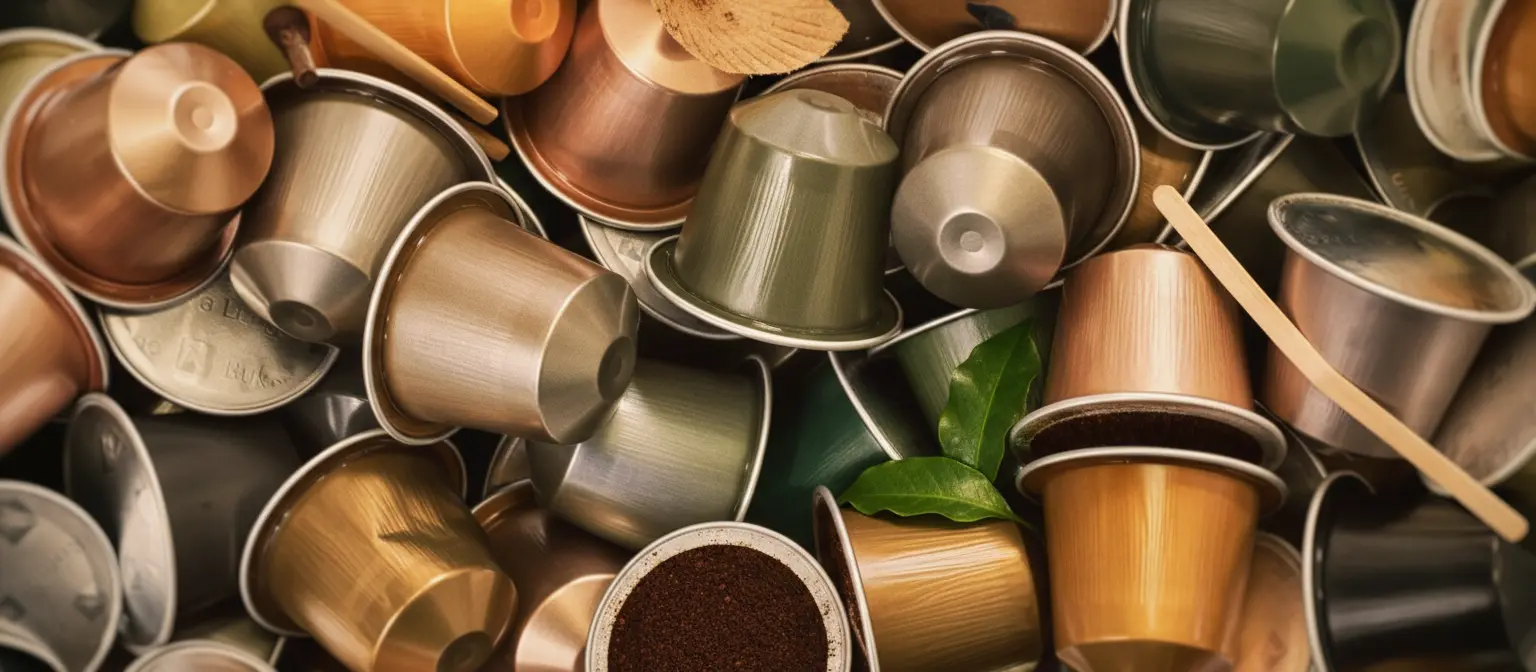
Stop tossing used coffee pods into the bin without a second thought. There’s a smart and sustainable trick doing the rounds—quite literally reopening the debate on what your morning espresso’s leftovers are good for! Get ready: your daily dose of caffeine could be the start of a whole new adventure for plastic waste.
The Coffee Pod Problem
Let’s face it: coffee capsules are everywhere, suiting every taste, and seducing roughly one in four French coffee drinkers, according to IFOP. Their practicality is hard to beat—pop them in, press a button, and voilà, joy in a cup. However, there’s a less joyful side effect. These beloved capsules create a staggering mountain of waste, much of which still haunts the environment long after the buzz wears off.
The numbers are sobering. In 2019, The Guardian reported that 20 billion individual pods were used worldwide every single year. While some of these pods are crafted from biodegradable elements or recyclable aluminum—which, in theory, can be reprocessed (though many French sorting centers can’t handle them)—there are still brands stubbornly sticking to plastic. And that’s a sticky problem. What’s the solution? Don’t worry, science has your back.
A Scientific Turnaround: Coffee Pods Reimagined
Hope is filtering through, fresh and hot. According to Forbes, Brazilian and British researchers have cracked a clever code to give plastic coffee pods a surprising second life. Published in ACS Sustainable Chemistry & Engineering in February, their study shows how the polylactic acid (PLA) found in these pods can be reused—not for another cup of joe, but in the world of 3D printing.
Yes, PLA can do more than hold your morning fix. The scientists discovered you can extract PLA from used capsules, add a dash of carbon black (no fancy barista skills needed—this amorphous, odorless element is found in soot, for example), and voilà: you can create sensors for measuring caffeine quality. Even the tools for testing your brew can come from the capsules themselves! Thanks to 3D printing, these scientists are closing the loop, turning waste into assets to test the next batch of beans. Now that’s what we call full circle.
How Many Lives Does a Capsule Have?
Skeptical? The team has successfully trialed their innovation, showing that the plastic from these coffee pods can be recycled up to three times before its quality takes a hit. To quote Bruno Campos Janegitz, one of the lead researchers, “The polymer base obtained from used capsules can generate high value-added devices.” In other words, yesterday’s pod isn’t just tomorrow’s trash—it could be tomorrow’s high-tech sensor.
The goal here isn’t just to clean up after ourselves. This innovation is part of a bigger ambition: boosting the circular economy. Rather than just making everything recyclable by banishing plastics, the researchers are keen to find ways to keep materials—whatever they are—useful and alive as long as possible. Forbes sums it up beautifully: focusing only on removing plastic from capsule design misses the point. The aim is to create a world where everything can continually find a new purpose.
- Pods can be recycled and reprocessed for use in 3D printing.
- With the right treatment, PLA-containing objects—think more than just coffee pods!—can become conductive plastics, opening nearly infinite possibilities.
- Each capsule can be recycled up to three times before losing quality.
Beyond the Last Drop: Circular Thinking in Practice
This joint Brazilian-British study isn’t just about coffee—it’s pioneering a path for recycling any PLA-containing object with 3D printing technologies. With the right know-how, these materials can become plastics with electrical conductivity, and the opportunities, as they say, are almost endless.
If all this makes you look at your empty coffee pod with new eyes, mission accomplished. Instead of thinking, “where’s the trash?”, perhaps the next question should be, “what could this become?” One thing’s for sure: the circular economy is stirring, and it just might start in your kitchen.

Iveta is an aspiring journalist with a passion for storytelling and a deep love for coffee. Always curious and creative, she dreams of sharing stories that inspire, inform, and connect people around the world


