
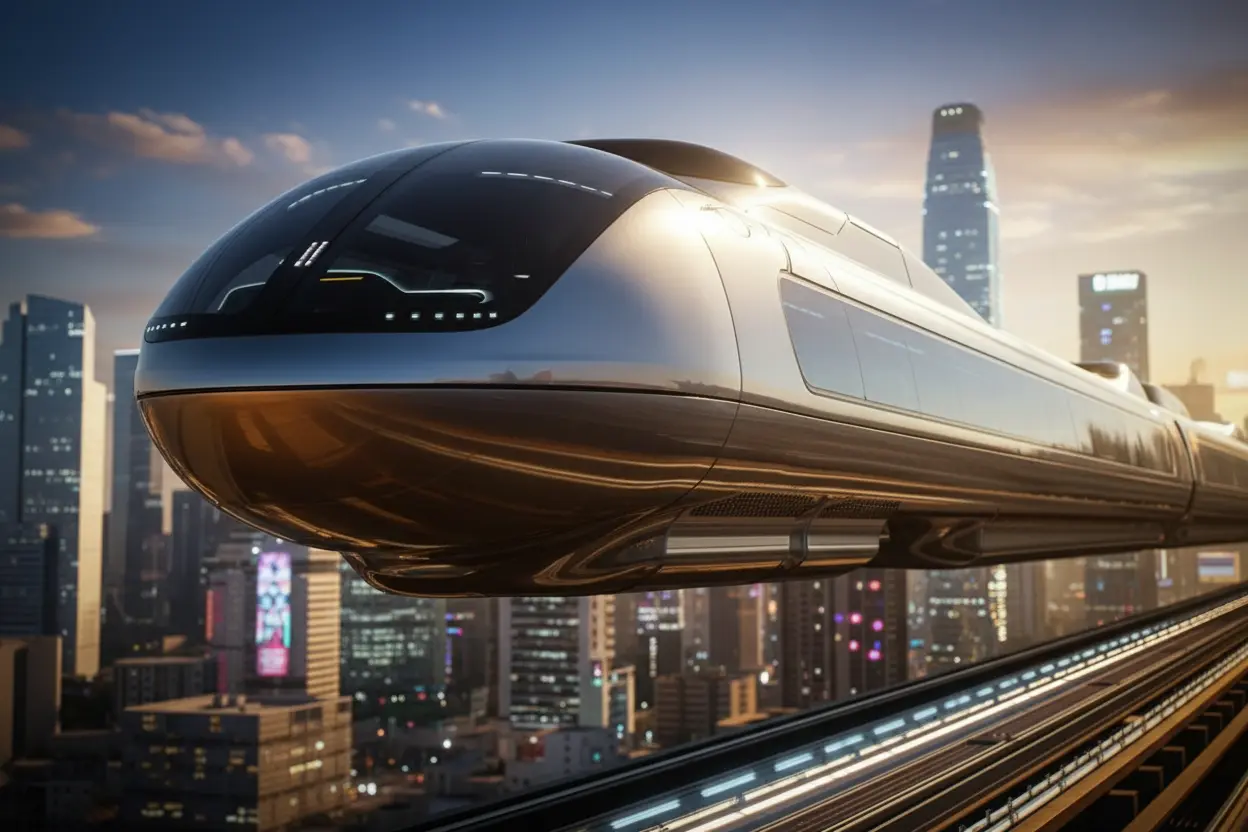
Imagine this: you’re at a bustling Chinese railway station, whizzing past at 350 km/h on a high-speed train seems the norm. Then, suddenly, there’s something above the rails, suspended inside a vacuum tube, aiming for speeds that would make even airplanes raise an eyebrow. Welcome to the future that Chinese engineers just experienced firsthand in Datong, Shanxi, during the first full-scale trial of China’s supersonic Hyperloop.
The Test That Turned Heads in Shanxi
On a 2-kilometer long test track, China’s maglev Hyperloop prototype showed off its cutting-edge capabilities. We’re talking about the successful integration of magnetic levitation suspensions and sophisticated control systems, all allowing the train to “fly” above the rails—courtesy of a low-pressure environment. Sure, the engineers are keeping the exact top speed under wraps, but word among specialists is that it nearly touched the dizzying figure of 1,000 km/h. To put it gently: that’s not just a hop, but a full-on quantum leap beyond what regular levitating trains can manage.
Strategic Ambition—and Lightning-Fast Construction
None of this happened by accident. The experimental Hyperloop track is the product of a partnership between the Shanxi provincial government and China Aerospace Science and Industry Corporation (CASIC). Their combined efforts sped up construction to record-breaking levels, underlining just how strategically urgent this program really is.
The finish line? Transforming city-to-city travel in China as we know it. Imagine going from Beijing to Shanghai in just ninety minutes. Say goodbye to the current eight-hour train ride, and even five hours by plane might start to feel unnecessarily sluggish.
Potential to Change Lives—But Not Without Hurdles
As someone who’s already had a taste of China’s high-speed train life, let me tell you: slashing travel times by hours doesn’t just change your calendar, it gives the whole economy a caffeine shot. But let’s not board the hype train too quickly—questions abound over whether this system can really be scaled up.
- The Hyperloop requires sealed tubes and specialized stations, which could trigger construction costs of epic proportions—and stretch financial feasibility to its limits.
- There’s the gargantuan task of integrating such a futuristic project with existing rail networks, not to mention considering the environmental impact of kilometers-long, low-pressure tunnels snaking across the country.
- Don’t forget maintenance: keeping everything safe and secure (especially in emergencies) is non-negotiable.
- And then there’s the cold, hard economics. Both public and private investors need assurance that the projected 15-billion-euro price tag will deliver real returns.
The Supersonic Dream—Is It Within Reach?
The vision of a train that could go toe-to-toe with airplanes for cross-country dominance has never felt closer. China’s supersonic Hyperloop might just be the golden ticket to a new dimension where speed and efficiency are the best of friends.
Yet, as the engineers and financiers alike will attest: significant technical and economic hurdles remain. Can China thread the needle and inaugurate this new era of travel? The answer, as always, will require as much persistence as radical innovation. So next time you’re at a train station watching the world speed by, just imagine what “fast” might look like tomorrow.

Iveta is an aspiring journalist with a passion for storytelling and a deep love for coffee. Always curious and creative, she dreams of sharing stories that inspire, inform, and connect people around the world


